Anybody Here Seen Mrs. Kelly?
A few days after Gene Kelly finished Crest Of The Wave in London, newspaper editors notified their reporters in New York to keep close watch on all ports of entry.
“Gene Kelly,” one waterfront newsman was told, “is the first and only actor to have spent seventeen months overseas under the old tax law. He has earned about $300,000, tax free. He is also responsible, in part, for the change of the tax laws by Congress. We want a story on him.”
Alert newsmen subjected every plane and ship passenger list to close scrutiny. When they were absolutely confident that Gene Kelly could never get into New York City undetected by the press, word came from Hollywood that Gene was back in movietown and that Arthur Freed, Metro’s chain-smoking producer, was throwing a big welcome-home party for the dancer.
The editors back east were fit to be tied. Verbally, they went to work on their waterfront and airport reporters. How in heaven’s name had they missed Kelly?
Chagrined, the reporters offered several alibis. One said that Kelly was traveling under an assumed name. Another said flatly that he got off his plane in Boston and caught a direct flight to Los Angeles. A third announced that Kelly was really in New York, having a series of wild parties in a midtown hotel while awaiting the return from Europe of his wife, Betsy, and his daughter, Kerry.
When Arthur Freed read this last item about his leading star, he blew his top. “We’re gonna sue that guy,” he stormed, naming the columnist who printed the defamation. “This time he has gone too far. He really has. We have a libel suit set to go. Sayin’ those things about Gene. Lies, all lies!”
In the midst of all this hullabaloo, Eugene Curran Kelly was his usual, calm, assured, astute self.
Sitting in the living room of Gene Tierney’s home—he had rented it until the lessees who had sublet his own were ready to go—he grinned his broad Irish grin.
“I don’t know what the fuss is all about,” he said. “Honestly! I took a plane from England and landed at Idlewild in New York. I traveled under my own name. I went through Customs and Immigration just like everyone else. It was a Sunday. Maybe that’s why the reporters missed me.
“Then I caught a plane to Pittsburgh. After all, I hadn’t seen my folks in over a year. I spent a couple of days with them and, incidentally, had a lot of fun with reporters from the Pittsburgh papers.
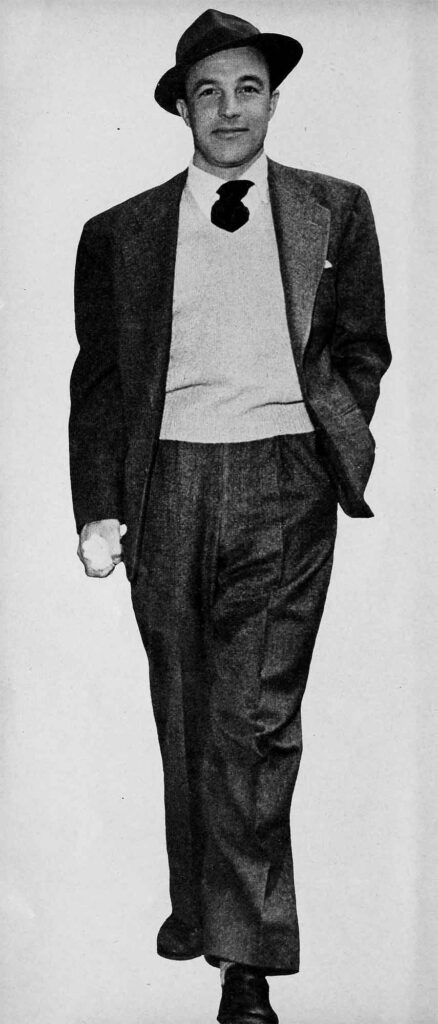
“After that, I came out here. Suddenly, there’s a lot of fuss. I’m not hiding from anyone. What have I got to hide? It’s no crime to take advantage of a favorable tax law. Besides, who cares? I’ve always paid my taxes. If the Government says I owe them money, I’ll pay. If they say I don’t, then I won’t.
“It’s as simple as that. Right now, I’m working hard on Invitation (Invitation To The Dance is one of the three films Kelly made while abroad) and we’re trying to work in some cartoon transitions. Betsy and Kerry will be home in a couple of weeks and they can tell you anything you want to know about Europe.”
That conversation should give you some small clue to the Gene Kelly personality. Here is a man who has no time for gossip, trivia, or inconsequential small talk. Let others rage at slandering columnists. Let others threaten to file their lawsuits. Gene has no time for legal battles, rumor denials, studio politics, feuds of any sort, or any such manifestations of the Hollywood social game. He and his wife, Betsy, stay out of night clubs, and he is probably the only Hollywood star earning $5,000 a week who doesn’t drive a Cadillac.
Most of Kelly’s life revolves around his work. Ray Boulting, the talented Englishman who directed Gene in Crest Of The Wave, says, “Kelly is probably the most accomplished player I’ve worked with. He’s absolutely sure of what he’s doing. And it isn’t just Hollywood slickness. He is a man of profound intelligence who is terribly well-grounded in all the fundamentals. Also, and this is very important, he loves to work.”
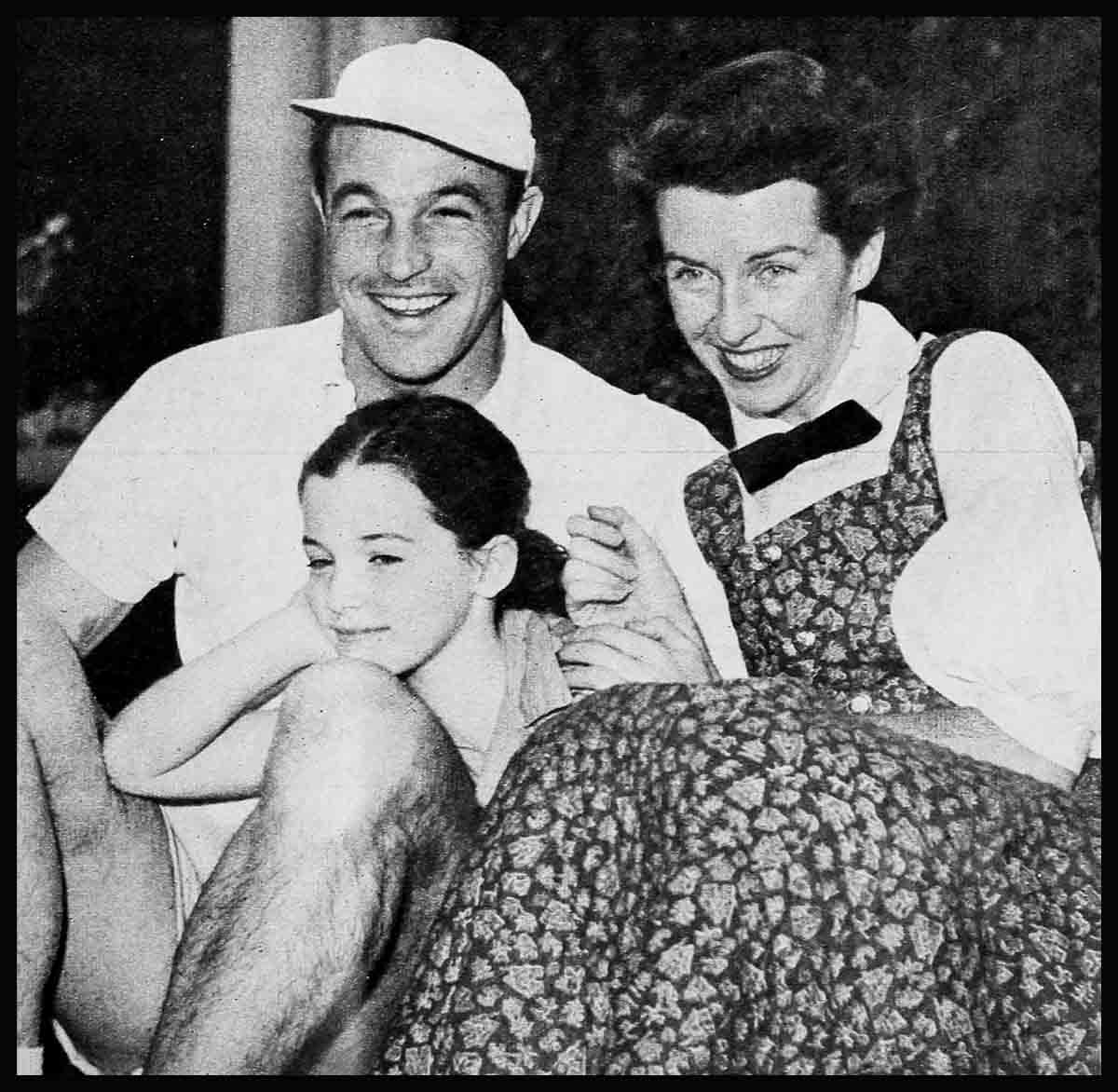
Friends of the Kellys predict that Gene’s obsession with work may yet lose him his demestic happiness, but his wife says, “That’s just nonsense. Kerry and I—well, we’re part of Gene’s work. Gene isn’t the kind of husband who divides his life into two segments: on the job at the studio and off the job at home. He spends many hours of the day and night working at home. Our house is filled with all sorts of studio workers. Dancing and directing and choreography aren’t something apart from us that Gene reserves for himself. All of us in the family are an integral part of his work. And he wants us to be. Some men shut their families out from their profession. Gene always includes us.”
Despite this, those who know the Kellys well are of the opinion that Gene should devote some of his time to his wife’s career.
“Gene and Betsy have been married for twelve years,” one friend explains, “and they’ve been very happy, but there is one obstacle which may throw them if it isn’t overcome, and that’s Betsy’s frustration.
“This girl has great talent. There’s no doubt about it. Ask anyone who has seen her perform. People still talk about her acting in The Snake Pit. When she and Kerry went over to Europe to join Gene, we hoped she might get a break overseas.
“She was offered a good role in England but she couldn’t get a labor permit, so she went to work for Anatole Litvak in France and in Italy as a combination coach and script girl.
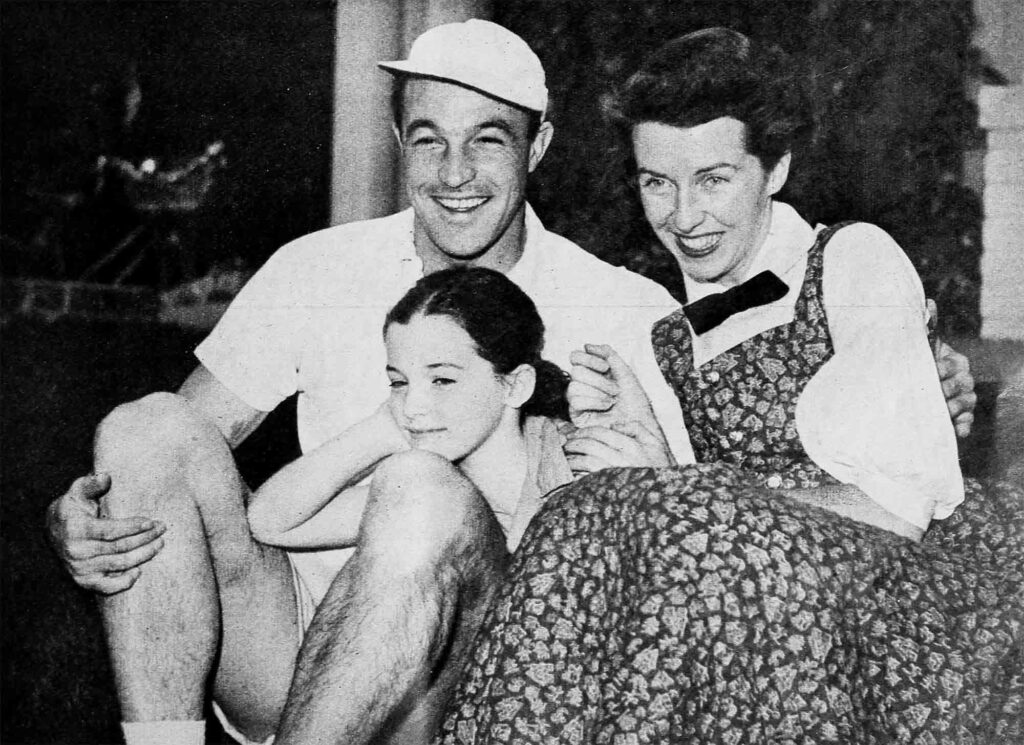
Betsy’s fine performance in he Snake Pit is still remembered. Now that Kerry, 9, is in school, Betsy has too much time on her hands.
“Betsy is crazy to have a career. After all, what can she do with her time? Kerry is nine and goes off to school each day. Gene goes off to the studio. Lois is a marvelous secretary and takes care of the mail and the bills. Servants look after the house.
“Betsy Kelly wants an acting job, but it’s the same old story. She is handicapped by being married to Gene. Why should any casting director hire her when there are hundreds of other young actresses who really need the money?
“This was the situation when Gene and Betsy left Hollywood almost two years ago. Gene has a great, constantly expanding career while Betsy, loaded with talent, drive, youth, and ambition, has none. We thought the situation would change in Europe, but no luck. Career-wise, Gene gets bigger, she gets smaller.”
Like her husband, Betsy Blair is frank, honest, down-to-earth, and unassuming. Ask her if she’s frustrated, and she tells you the truth. “Of course I’m frustrated,” she says, “but so are a lot of other actresses. I want to work but I can’t find the jobs. Certainly, it isn’t Gene’s fault. Anything I want to do in the way of a career is all right with him. He never has objected to that.”
Kelly knows that his young wife is a fine actress, but he dislikes nepotism, and he would never use his own power or prestige to advance his wife’s career. He feels that if Betsy is going to make it to the top, she’s going to make it through her own efforts. And he has a deep, abiding faith in her eventual success.
One of Betsy’s friends says, “I can’t figure Betsy, at all. Why doesn’t she give up all this career pretension? Why doesn’t she have four or five more kids and raise a big family? Now that Gene has a new contract and all that tax-free money, she isn’t going to have any financial worries. Besides, the Kellys have always lived modestly. To my way of thinking, this girl has everything: a successful husband, a beautiful daughter, a nice home, money in the bank. Why does she want to knock herself out?”
The Kellys would like to enlarge their family, but even if they should, Betsy Blair would yearn for a career. She is one girl who has always wanted to entertain. She went to work as a dancer when she was only fourteen. Show business is in her blood, and she cannot drive it out.
She wasn’t yet eighteen when she was married to Gene in 1941, and in the ensuing decade she succeeded in sublimnating her ambition. As she approaches thirty, however, she feels that her acting career will have to start now or never.
Kelly who doesn’t like to discuss his private life, says anything that will make Betsy happy is fine with him. He understands and appreciates her frustration, but he is sure it offers no threat to their marriage.
“Essentially,” he says, “Betsy is a very sensible girl with very sound values. She knows that it is virtually impossible for two careers in one family to be equal.”
As for his concentration on his work, Gene says, “They’ll have to carry me, feet-first, off the dance floor before I retire. Right now, I’m as strong as a horse. I want to act and dance and direct, and I don’t ever want to stop.
“Invitation To The Dance was my first straight directing job, but we didn’t shoot it for a wide screen, and if they show it on one, they’ll ruin it. But I think that from the point of view of the dancer and the choreographer, these new dimensional techniques—3-D, CinemaScope, and the others—are great, because they give the screen what it’s always lacked, depth and the illusion of dancing on the stage.”
When Kelly started out to make Invitation To The Dance, a full-length feature told only in mime and ballet, several studio executives called him in and said, “Why do you want to make a dance film without words? You must be nuts.”
Gene explained what he had in mind, and the studio had such great faith in him that he was given the go-ahead. Two Decembers ago, he flew overseas, made a quickie in Munich, and then began to hire ballet dancers for Invitation. Now finished, the film has several non-dialogue ballets strung together. Theoretically, this picture will raise the aesthetic level of the film musical to an all-time high.
Of all his musicals, Kelly claims, “On The Town is my favorite, although I’ve danced better in other films than I did in that. I think I did my best dancing in Anchors Aweigh but On The Town was important, a different kind of a musical.”
Of the three Kellys who went abroad, Gene was the first to return. He has been in Hollywood since August. Betsy, Kerry, and Lois McLelland, Gene’s secretary, stayed behind in Paris, and a few weeks later, Lois and Kerry flew back to the States. Kerry spent some time with her grandma and grandpa Boger in New Jersey and arrived in Beverly Hills early in September, in time for school-opening. She was elected president of her class.
Betsy closed the picturesque apartment the Kellys had rented in Paris and was the last of the wandering tribe to pull into Hollywood. The family lived in Gene Tierney’s home in September and finally got back into their own home in October.
Now that Gene is hard at work, Kerry is going to school, and Betsy is looking for an acting job, it seems to the Kelly trio that they’ve never left home.
They are still one of Holtywood’s truly happy families, and should Betsy get one good break, they will be the happiest. Until then, and this is one of the French sayings the Kellys learned in France, “Plus ca change, plus c’est la méme chose.” The more things change, the more they are the same.
THE END
—BY ALICE FINLETTER
It is a quote. MODERN SCREEN MAGAZINE DECEMBER 1953