The Man Behind The Face—Jack Palance
There are acting discoveries by the hundreds each year, but once in a decade a man like Jack Palance shows up, shoulders his way into the spotlight, forcing the real men of Hollywood to move-over. Then, because there is room for just so many important male stars, some guy whose virility and talent are optical illusions drops quietly back into oblivion.
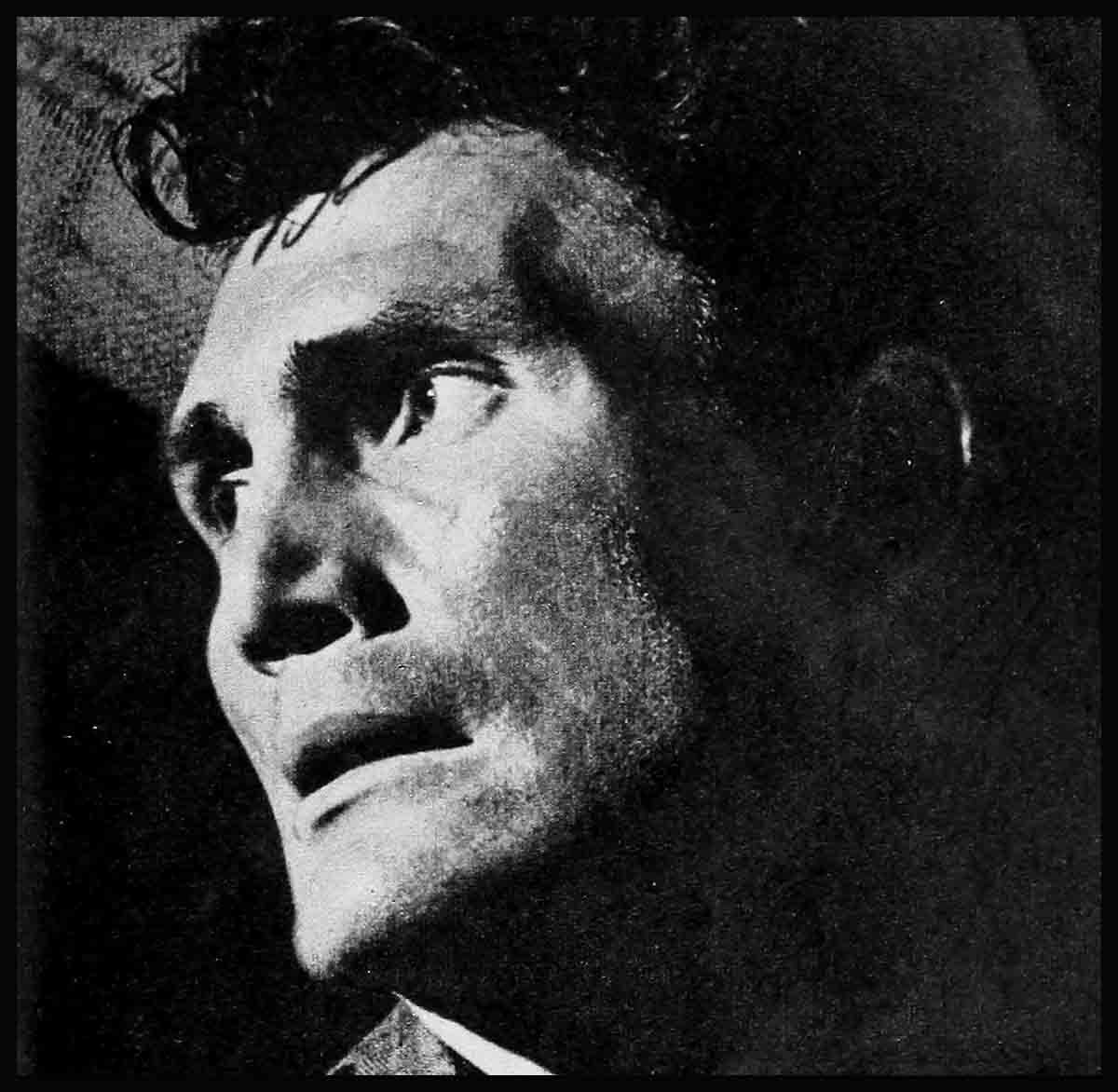
Jack Palance jolted the public for the first time in the role of a man with murder on his mind; the sadistic husband of Joan Crawford in Sudden Fear. That he wasn’t promptly promoted to stardom is due to the curious: fact that producers constantly cry for new faces, but when they see one as compelling and different as Mr. Palance’s, they are thrown for a loss.
In this quandary they have had something in common with Palance, for he didn’t always have this face. He doesn’t like to talk about it, but his nose has been broken more times than he can remember. And at one time he spent many months hiding away in a furnished room in New York, struggling with the fear that he would never again look human. The face, which is now so familiar and approved by the public had been burned beyond recognition, even by his mother.
“I don’t see much in my life to dramatize,” Jack Palance will tell you after the manner of most men chosen by fate to face brutal experiences few of us ever suffer. “It’s true that I was the son of a coal miner in Lattimer, Pennsylvania, and that my family was what might be called ‘desperate poor, but we didn’t know it. If you grow up in a town which is almost treeless and emphatically black and grey, it never occurs to you that life has played a dirty trick on you. Yes, compared to a town in which there are trees, flowers and lakes, Lattimer could be called a grim place. But the good Lord has a way of balancing the books in favor of people like us. Among the citizens of Lattimer there is probably more of honesty, loyalty, love and pure decency than almost anywhere else on earth.”
You could expect a boy like Jack Palance to grow up into a street corner rabble-rouser, or worse, living as he did in a “company” town. His mother had to pay $1.10 a pound for butter. She could buy the same butter in a town just a few miles away for eighty-seven cents, but resisted the temptation to economize for fear her muskand would be fired from his mining job.
“We were poor,” Jack Palance remembers, “but we were never hungry. When the miners went on strike for months at a time, we didn’t have meat on the table. We had all the vegetables we could eat, though. I weigh about 200 pounds now, which ought to be proof enough that I didn’t starve to death as a kid.”
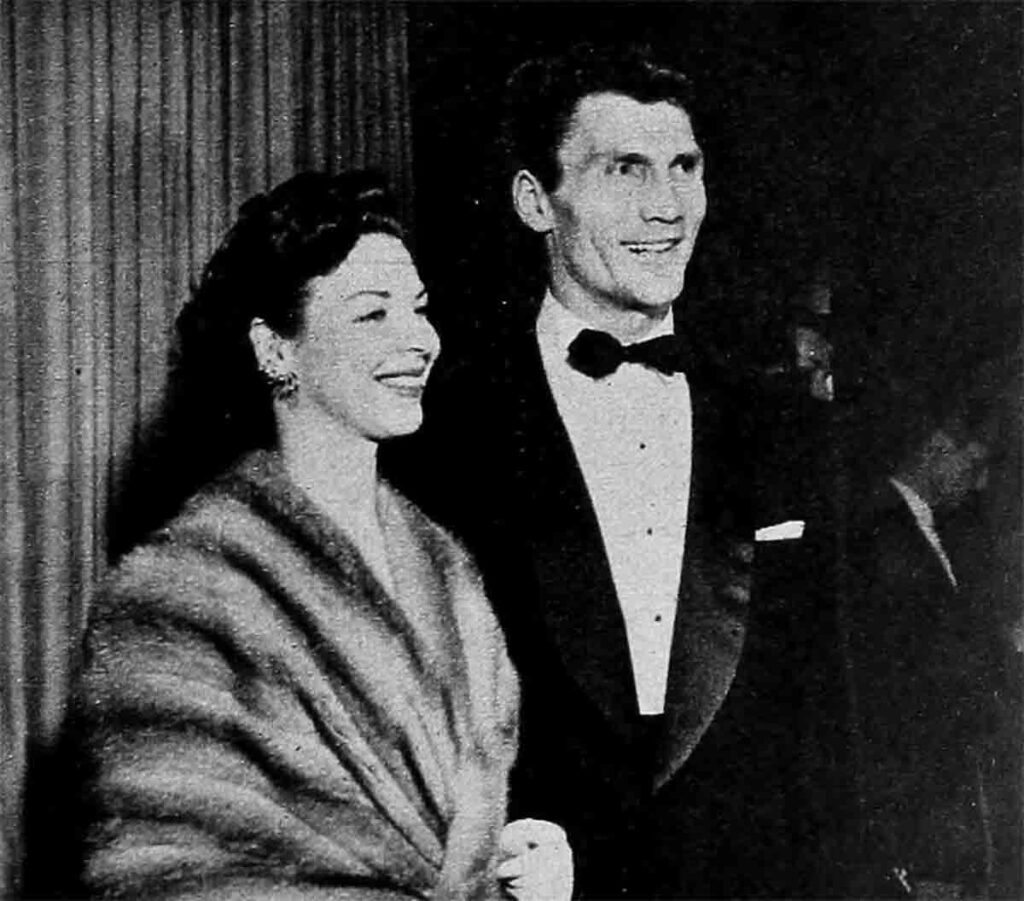
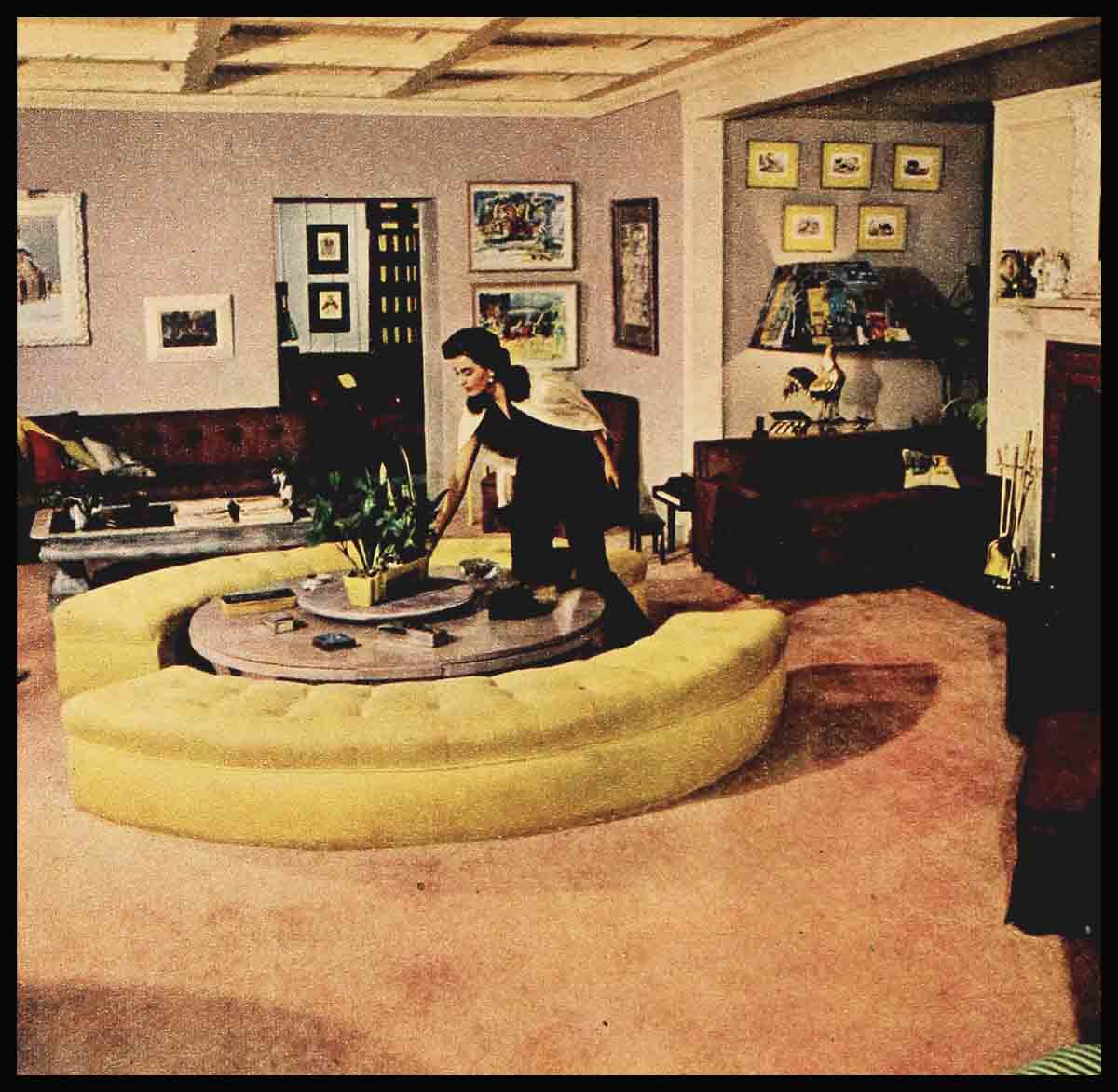
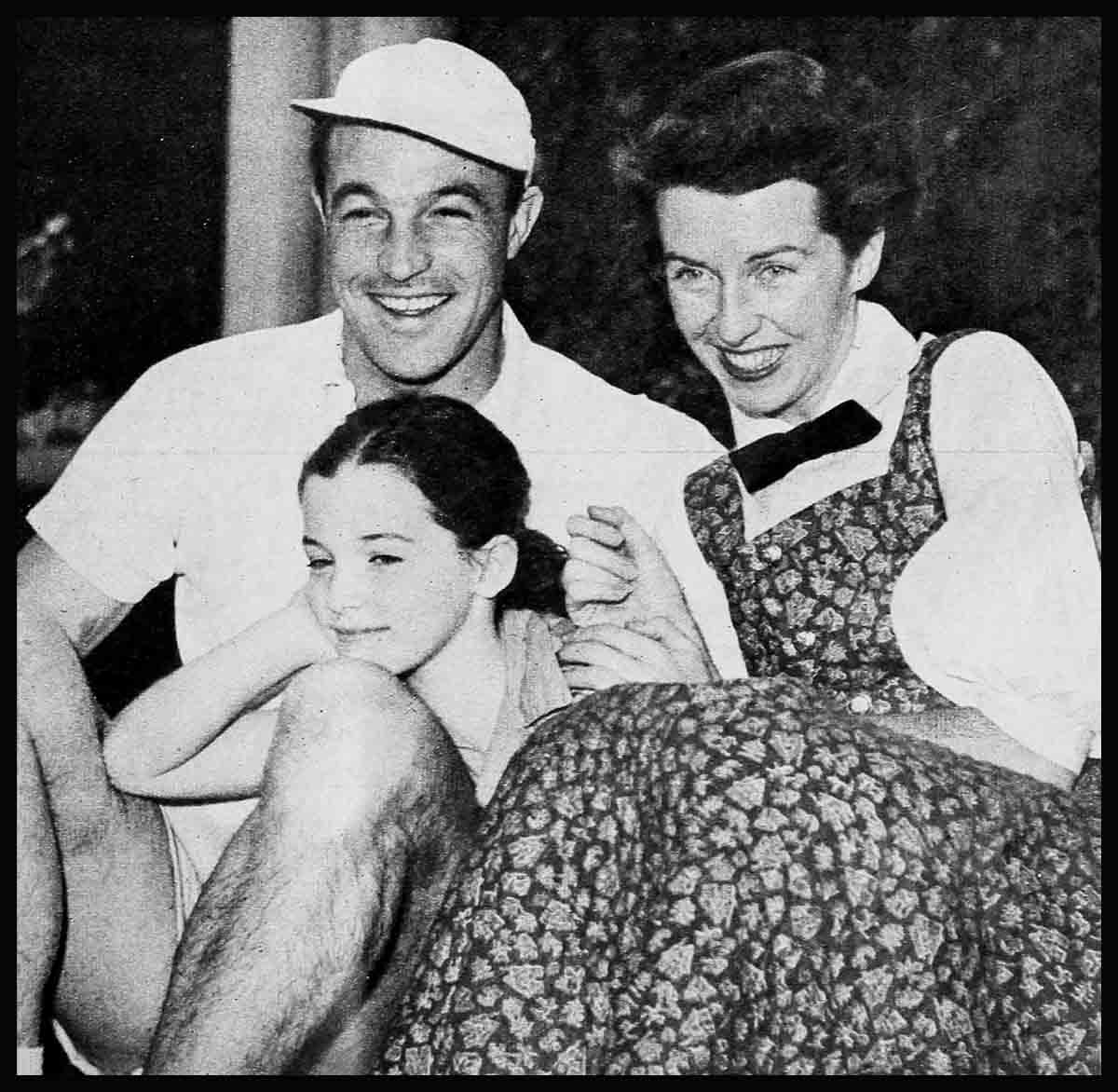
Jack met wife Virginia in a theatre basement, later hocked his suits to pay for their honeymoon. Daughter Holley is named after their Greenwich Village honeymoon hotel.
With all his acceptance of a bleak childhood, Jack Palance was not a happy boy. From the time he learned to read, he had an insatiable appetite for books and felt it made him “different” from other kids. To compensate for this, he turned to fighting, climbing into a ring for the first time at the age of thirteen and turning in a creditable performance against a twentyone-year-old pug. The prize money was $1.50, winner take a buck. They fought to a draw for a split purse—seventy-five cents each.
“That’s where I got my nose broken the first time,” Jack says. “I did fair as a fighter, but I was scared as hell a lot of the time. The worst night I ever spent was in a ring with a guy by the name of Rough House Williams. I was fully grown before I was out of my teens. Stood six, four, and weighed over 200 pounds. But when I looked across the ring at Rough House I felt like crying. I had watched him work out in the little town near Louisville, Kentucky, where we were fighting, and I’d have preferred to trade left hooks with a gorilla.”
As the bell sounded, Palance moved to the center of the ring. Rough House did likewise. Then Palance moved. back, but fast. He kept on back-pedaling. The crowd booed. Palance clinched and Rough House tore a hard right through his midsection. Palance broke loose, backing into the ropes. Rough House picked up a left hand from somewhere near the floor.
“When he caught me on the side of the chin, I went three feet up in the air. The bell rang before I could get up. I wished it hadn’t. While my handlers were slapping me sensible, the referee came over with a few words of encouragement. He said I’d either have to start fighting or he’d give the decision to Rough House.
“I went out for the second round. Rough House looked even tougher. I told myself to make a fight of it, but all the while I was running around the ring like a monkey looking for an opening in his cage. When Rough House caught up with me, he tore me apart. My eyes popped out like Eddie Cantor’s. My hands swung like a couple of windmills. Then everything went blank. I felt somebody holding me up with my right hand ridiculously up in the air, and because I couldn’t hold my head up, I stared down at the canvas. There was Rough House, stretched colder than a mackerel in a deep freeze. He didn’t know what had hit him. To be frank, neither did I. I’d knocked him out by accident, and if the referee had. told me that he’d done me a favor by hitting Rough House with a baseball bat, I would have believed him.”
This confession is not to be taken as an invitation for anyone to step up and try his luck with Jack Palance. He’s not quite as tough as he looks on the screen, but almost.
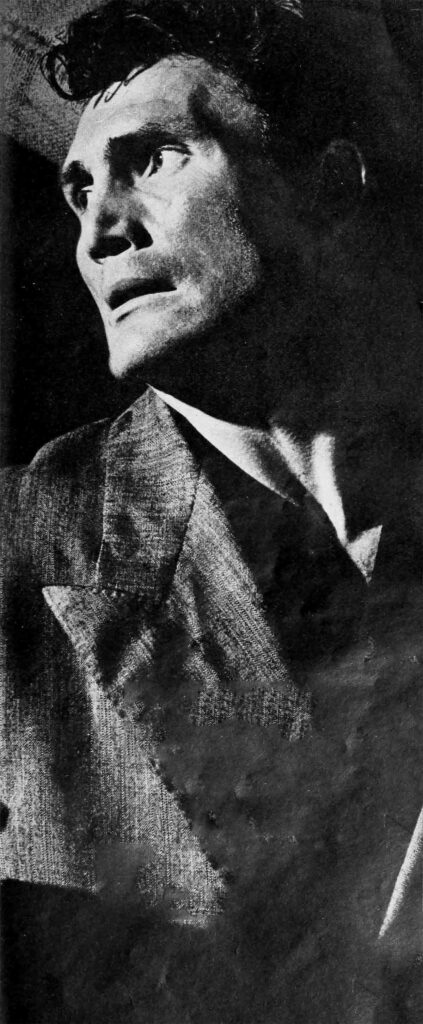
As is usually the case with capable men, he doesn’t make speeches about his physical prowess and he goes to considerable lengths to picture himself as just an average guy.
Fighting, Palance believes, can be fun.
Not, however, if you have a nose that needs a remodeling job every time it is touched by a soft jab. As for fighting for profit, Palance was never knocked out during his ring career; still, the most he ever earned for one fight was $400. Now he earns more than five times that in a week.
It is necessary now to pry more deeply into the life of this remarkable actor to understand what there is about him, inwardly, that causes his personality to project so powerfully on the screen. To put it more precisely, Jack Palance is a man who has been “to hell and back,” within himself. He can’t be blamed if he doesn’t want to talk about it.
“The little accident” Lieutenant Jack Palance had when his B-24 crashed on takeoff during the war near Tucson, Arizona, WaS no minor experience. The plane burst into flame. Palance dragged himself out alive and in flames. In the months that followed he wished himself dead. His whole face was a mass of scar tissue. Delicate operations followed, one after another. Those who see his face now for the first time on the screen are slightly taken aback. The expression is one of gaunt strength and contained fury, which thousands of women moviegoers find highly exciting. If the phrase “contained fury” is inadequate, there are no words that come anywhere near what Palance thought of his face for months after the accident. He avoided looking at himself in the mirror. Despite the fact that those who knew him could notice miraculous improvement, he couldn’t. The entire experience was one long nightmare in which he had lost his original face and was being given a new one.
Courage is also an insufficient word to describe the strength with which he emerged from the fear of being seen in public and went again about the business of living, enrolling at Stanford University under the GI bill as a student in radio acting and short story writing. Somewhere along the line, he whipped the complexes about his facial appearance. He went on to New York, by way of such jobs as short order cook, life guard and ice cream salesman, at last landing an important role in the Broadway show, The Big Two, directed by Bob Montgomery. Everybody loved the play but the critics and the audience. It folded in three weeks.
Jack had just enough money left to pay his room rent and get on to Chicago. Here his budding career sank to another depth. He understudied Anthony Quinn in the Windy City company of A Streetcar Named Desire, a job in which he was as important to show business as last week’s issue of Variety. Every night he sat in his basement dressing room reading a heavy book called The Anatomy Of Melancholy.
But he was not alone in his misery. In the dressing room next door sat a girl named Virginia Baker, who understudied the Vivien Leigh role. Although Helen Hayes has pronounced her the most capable young dramatic aspirant in New York, then she was as much a “nothing” as the moody Mr. Palance.
One. evening, when she no longer could stand being buried beneath the street while audiences cheered the powerful play going on above her head, Virginia went to Jack and said, “Let’s go to a movie.”
The picture had a title appropriate for the two of them—Sorry, Wrong Number. They felt like a couple of wrong numbers and Jack had the same opinion of the picture. Somewhere along in the middle, he left the theatre. At the final fadeout he came back to his seat. Virginia said, “You’re a charming escort. Where’ve you been?”
“I didn’t like it so I went out for a beer.”
Virginia made a mental note that Mr. Palance was strictly a foul ball, square type. But a few nights later leading man Tony Quinn was attacked by a strep throat. Now, understudy Palance had his big chance to rise from the dressing room graveyard and face an audience in a hit play.
“I was curious to see if Jack was a more inspired actor than he was a date,” Virginia admits, “so I sat out front that night. It was the surprise of my life. He was not just good. He was great. When he walked out from the wings, sparks flew. To my dismay, I fell in love with him.”
For Jack, the triumph was short lived. He had the part for two performances, then had to go back to his basement dressing room. Virginia loyally explained, “Maybe Tony heard how sensational Jack was. Anyhow, he got well overnight. As for me, I woke up in a hurry. First, I realized that Mary Welsh was far too healthy for me to hope to step out of the understudy role. Second, and a lot more important, I had to get out of Chicago. I was an actress trying to get started. I had fallen in love with a guy who had shown me that he preferred a bottle of beer to my company. It didn’t make sense.”
Virginia went back to New York and Jack went on the road with Streetcar. But he suddenly missed the girl who had shared his misery in the Chicago theatre basement, and he followed her with a series of letters climaxed by a Christmas Eve proposal. Virginia was touched and a little frightened. She flew to Detroit to tell Jack why she couldn’t become Mrs. Palance.
Then, less than a month later, Marlon Brando, who was playing the role in New York unconsciously took an important part in their romance by breaking his nose. The producers needed Jack Palance immediately. He had quit the road show and nobody knew where to find him. They checked with Virginia, who called all the relatives she knew, finally locating him at a cocktail party in Greenwich Village. Jack climbed aboard Streetcar again, grateful for Virginia’s detective work.
“I don’t know exactly when we decided to marry,” Virginia went on, “but I think I must have started the proposal. At least I know that I cued him. At any rate, we were married in New York’s Little Church Around the Corner on April 12, 1949. By this time we were both out of jobs. Even so, Jack insisted that we have a honeymoon, so we checked in at the Hotel Holley on Washington Square. I didn’t realize that we were dead broke until I noticed that Jack began to take his suits to the cleaners and they never came back. He was hocking them to keep us going.”
Then the gods of the theatre apparently went into executive session to see what they could do about these two. Immediately they came up with a couple of small parts, then the Hollywood call to play the role of the heroic Marine in Halls Of Montezuma. This, of course, was followed by Panic In The Streets.
During Halls Of Montezuma Virginia was concentrating on motherhood. For weeks Jack had been coming home to say, “Don’t you think it’s about time you went to the hospital?” One evening, Virginia talked him into going to see the play, Death Of A Salesman, to ease his nerves. When he arrived home at midnight she said, “Jack, the baby’s on the way.”
“Oh, no,” he moaned. “Not tonight!”
Obediently, he backed out the car again and they started for the Good Samaritan Hospital, which isn’t easy to find even when you know where it is. He made the wrong turn off the freeway, and after checking with three gas stations finally found the place. “Poor guy,” Virginia remembers. “I insisted on a natural birth so he stayed with me almost all night while I tried to prove that it didn’t hurt. We decided to name the baby Holley after our honeymoon hotel. I don’t know how Jack stayed awake on the set the next day, but the ordeal must have helped because the se told him his work was particularly good.”
Father Palance was not too happy about his career, however. It seemed that all the good parts at 20th Century were going to handsome guys. So he chose to make an issue of his being cast in Viva Zapata! to break his contract.
“Probably that was stupid on my part, because Tony Quinn, whose understudy I had been for so many months, took it and played it into an Academy Award. For my part, however, I was lucky. I went back to New York and into Darkness At Noon, which seemed to more or less establish me as an acting commodity.”
That’s putting it modestly. Audiences shook the rafters with their applause. Television and movie offers, specifically for Sudden Fear and Shane, snowed him under. Jack left Virginia and the baby in their apartment on Central Park in New York and began to commute.
“He was in Hollywood when Brook was born,” said Virginia, “and I was glad. Fathers have such a terrible enna struggle at a time like this. As for me, I simply took a taxi to the hospital. The cab driver was very helpful. He never asked where my husband might be.”
Even if movies don’t wake up to the fact that Jack Palance is considerably more than the most terrifying “heavy” Hollywood has ever seen, TV certainly has, as evidenced by the fact that Suspense for the first time is splitting itself into two half-hour shows in order to allow Jack to star in Othello. If that doesn’t do the trick, persuasive movie fans may help io show producers the way. They certainly haven’t been asleep at the post, as witness the letter written by one Modern Screen reader to a movie boss: “Why do you insist on casting Jack Palance as such ugly characters? Sooner or later you’ll discover that the public has already marked him as a star. It isn’t necessary for him to frighten the first five rows of customers stiff to prove himself a fine actor. It’s not the face, but the man behind the face that counts!”
The young lady never said it better. Her letter and hundreds of others may have already turned the trick, for although Jack Palance has been killed in five of his six pictures, a bulletin on his future has just come through as follows: “In his next picture, Flight To Tangier, Mr. Palance plays the hero and wins not one but two heroines.”
That you’ve got to see!
THE END
—BY JACK WADE
It is a quote. MODERN SCREEN MAGAZINE DECEMBER 1953