

Did Elvis Presley Give Connie Stevens The Brushoff?
Once again Connie Stevens heard the hateful clink of a coin coming back at her. She fished her finger into the phone’s metal pocket to retrieve her dime. The famous Stevens temper had already risen—now it was compounded with frustration and disappointment.
“Oh, oh, oh . . . !” She gave the wall of the booth a good kick—a substitute for the language she knew she shouldn’t use. “Oh, if only I’d written . . . but I never imagined . . .” She was muttering to herself.
She dropped the dime into the slot again. A new idea: this time she dialed Western Union.
“I’d like to send a telegram,” she told the voice that answered. “To Mr. Elvis Presley.” This was her last resort—a telegram!
When Connie had accepted an invitation to tour Mississippi in May, she’d told her friends—and herself—that it made sense to plan a stopover in Memphis. Why? Well, it was the logical place to spend May 1—in rehearsing and organizing her material for her Mississippi tour. Memphis, she said to anybody who questioned the stopover, is a large city with rehearsal facilities and comfortable hotels.
But she didn’t mention another of its distinguishing characteristics: that it’s the hometown of Elvis Presley. And that he just happened to be in Tennessee in May, between pictures.
Almost two years ago, magazines and columnists gave lots of space to a suspected romance between Elvis and Connie. But the stories weren’t pure invention. Connie and Elvis were behaving in a way to make fans wonder just how much they really did mean to each other. When any girl dates Elvis it’s news. And with Connie it was more so, because Glenn Ford was reputed to be his rival. Connie was having one of her recurrent tiffs with Gary Clarke, and Hollywood was betting on who’d be her next steady—Elvis or Glenn!
Connie had visited Elvis when the “Kid Galahad” company went on location to a romantic, remote mountain top at Idyllwild. In a pine-scented setting, they had the perfect opportunity to fall in love. But the truth is: they didn’t. Connie didn’t come down from the mountain with stars in her eyes or a new rhythm to her heartbeat. Elvis didn’t ask her when she’d like to begin redecorating Graceland.
As a matter of fact, neither had a free heart to give away. Spats or no spats, Connie knew she was still Gary Clarke’s girl. And Elvis was still sentimentally attached to Anita Wood, the pretty Memphis girl he’d courted for more than three years.
No, Connie and Elvis weren’t in love—not with each other. They just loved to be together—each loved many qualities in the other. But being in love and loving aren’t the same thing.
Now, in the Memphis phone booth, Connie emptied her purse on the shelf and sorted out coins to pay for the wire.
“If only I’d written to say that I was coming!” she moaned to herself again. “But I’m such a terrible letter writer!” Besides, how could Connie Stevens expect she wouldn’t be believed when she said she was Connie Stevens? Now she’d have to wire him, and waste another hour she could be spending with him!

But why Memphis?
It had all seemed so simple when she’d planned this stop. And as her plane had approached Memphis, she’d been humming a little tune under her breath in happy expectation. Just what was she expecting, she’d wondered.
After checking into a hotel, Connie made a few important business arrangements about her personal appearances the next day. Then she hurried to a phone booth. She deposited a dime and dialed Information.
“Information.” The pat voice had the same inflection as in every city of the nation.
“I’d like the number for Elvis Presley,” Connie said. “I know his number is unlisted, but I’m a friend of his from the West Coast, and it’s important that I reach him.”
“I’m sorry,” Information’s answer came so automatically that Connie realized instantly: she must have heard the same story from thousands of girls. “I don’t have the number for Mr. Presley.”
“But,” Connie insisted, “I really am a friend of his from the West Coast. Really I am. I’m Connie Stevens. I’ll only be in Memphis one day, and it’s terribly important that I get in touch with Elvis.”
Terribly important? Connie was suddenly aware that she’d used almost the same words twice. She surprised herself with their urgency. Just how important was it, really, that she see the tall, reserved Tennessean whose unaffected gallantry, honesty and good common sense had impressed her so favorably. And she remembered something she had said one afternoon at the height of the excitement over the Ford-Stevens-Presley triangle.
“I feel deeply honored to be Elvis’ friend,” she had confided. “The first time he asked me for a date, I couldn’t imagine why he wanted to go out with me. Frankly, I was prejudiced against him, because I couldn’t think of anything we’d have in common. But after a little while I knew he was one of the finest people I’d ever met. He’s naturally kind and thoughtful and good. Best of all, in spite of his huge success, he’s unassuming.”
If anybody could appreciate the hard work that had brought Elvis from poverty and obscurity to wealth and stardom, it was Connie. She’d been poor, too. And had worked hard. She knew, all right, the character and endurance it took to make the climb as Elvis had.
Elvis, for his part, had liked Conine more every time they were together.
“You know,” he said admiringly to a reporter, “she used to clerk in a blouse shop. She’s a sensible, hard working girl—and a real pretty one.”
Someone had observed that, to be ideally suited to one another, a man and woman should be alike in fifty percent of their background and temperament, and opposites in the other half. Connie and Elvis fill this prescription exactly. She is a big city girl, born and bred to the hustle of the metropolis. Elvis, even though his family moved to Memphis when he was in junior high school, is a country boy. The soil, not the sidewalks, was the foundation of his youth.
Connie is Catholic. Elvis is Protestant. Elvis’ parents were devoted. Connie’s were divorced. These are some of the opposites.
But in other respects they are remarkably alike. A little joke defines a Hollywood aristocrat as “a fellow who can trace his family all the way back to his father.” Truthfully, to many in Hollywood’s restless, shifting population, family connections mean nothing. But both Connie and Elvis know and value their kin including cousins several times removed. In the lean days, when they had little else to give them a feeling of security, each had drawn strength and love from their families.
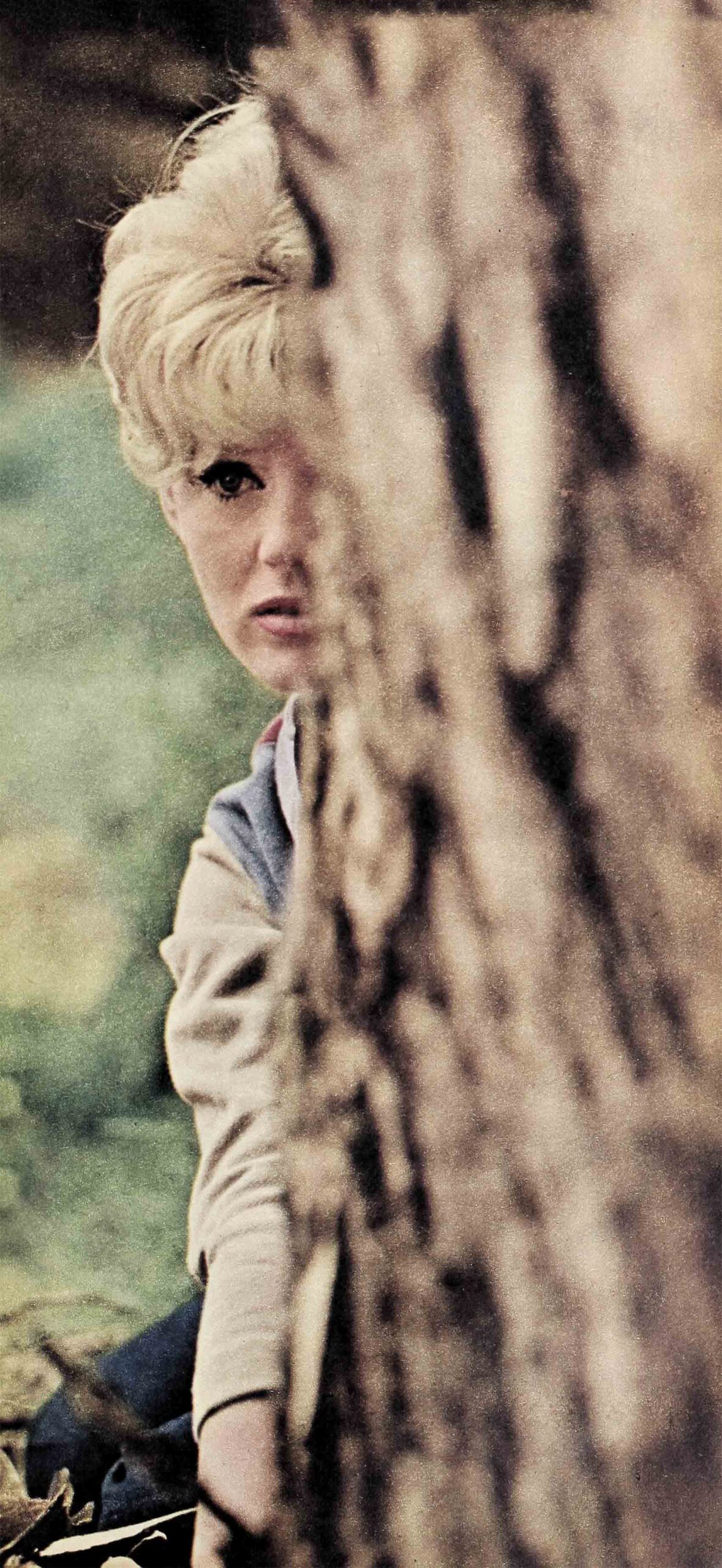
Marriage—but to whom?
Connie and Elvis are each determined to forge a lasting marriage—for reasons that are different and reasons that are the same. Connie’s hunger for one permanence is, in part, her reaction to her parents’ divorce. Elvis, on the other hand, is influenced by his parents’ perfect relationship that ended only when his mother died. He doesn’t want to settle for less. He’s looking for a girl who shares this ideal.
Religious conviction is a common ground on which Connie and Elvis found their philosophy, even though their religions aren’t the same. To each, marriage is extremely sacred. In the north Mississippi country where Elvis was born, divorce is rare, and it’s frowned on just as surely as it is in the Vatican.
Connie and Elvis have another compelling common denominator—their love for music. To each, singing is a way of life.
Now, as Connie pleaded with the Memphis Information, was she aware of the logic behind their mutual attraction?
“Please,” she begged the impersonal voice, “please, you have to believe me.” She had an idea. “Look—do you watch television? Do you watch ‘Hawaiian Eye?’ I’m the girl who plays Cricket on the show. Listen and maybe you’ll recognize my voice.”
She sang a few bars.
“Don’t I sound familiar?” she asked wistfully.
“Look, honey,” Information said, suddenly becoming personal and kindly, “Every time a movie magazine comes out with a story saying Elvis is dating one girl or another, dozens of girls claim to be the one in the story and they ask for his number. If a girl’s dating him, why doesn’t she know his number?”
“Last time I saw him,” Connie explained, “I had no idea I’d be in Memphis.”
But she realized the explanation sounded thin.
“Honestly,” Information continued, “girls call and claim to be his fifth grade teacher—you know, the one who first encouraged him to sing. Or they say they used to live next door to him, or they knew him in Germany. I feel real sorry for some of them. They cry.”
Connie wondered whether she were going to cry, too. In disappointment. In anger.
“And even if I were sure you were Connie Stevens,” Information went on, “I couldn’t give you Elvis’ number. I can’t give it to anyone—not even to Elvis if he was trying to call his house and forgot his own number. That’s how it is with unlisted numbers.”
Suddenly she said. “But let me give you my supervisor. Maybe she can help you.”
Unheard by Connie, another girl at the telephone company switchboard chided Information.
“Passing the buck, aren’t you?” she laughed.
“Well, she said she’s Connie Stevens, and she does sound like her.”
“Yeah, and I’m Elizabeth Taylor!”
Little Connie won the Hollywood Press Women’s Golden Apple Award this year as most cooperative actress, because she was the girl who would talk about anything within the bounds of good taste. She was the reporters’ delight who said. “You can write anything you want about me, just so it’s not too far out”—but that was before she broke her engagement to Gary in February.
When Connie went to Memphis, she was on the rebound—highly susceptible to love. Gary’s absence left a big, aching emptiness in her heart and her life.
Elvis, too, was subconsciously looking for someone to banish loneliness—someone who wouldn’t remind him of Anita, but would take her place. They’d broker, up a month before Connie and Gary did, and he’d said of Anita, “When you’ve been used to somebody for so long, you’re bound to miss her.”
Although Elvis hadn’t invited a girl from out of town to visit him in Memphis since his pre-Army days—since, in fact, he became seriously interested in Anita—he did welcome a mysterious female guest to Graceland just before Connie arrived in his home town. Reportedly, the attractive stranger was a girl Elvis had dated in Germany while he was there in the Army.
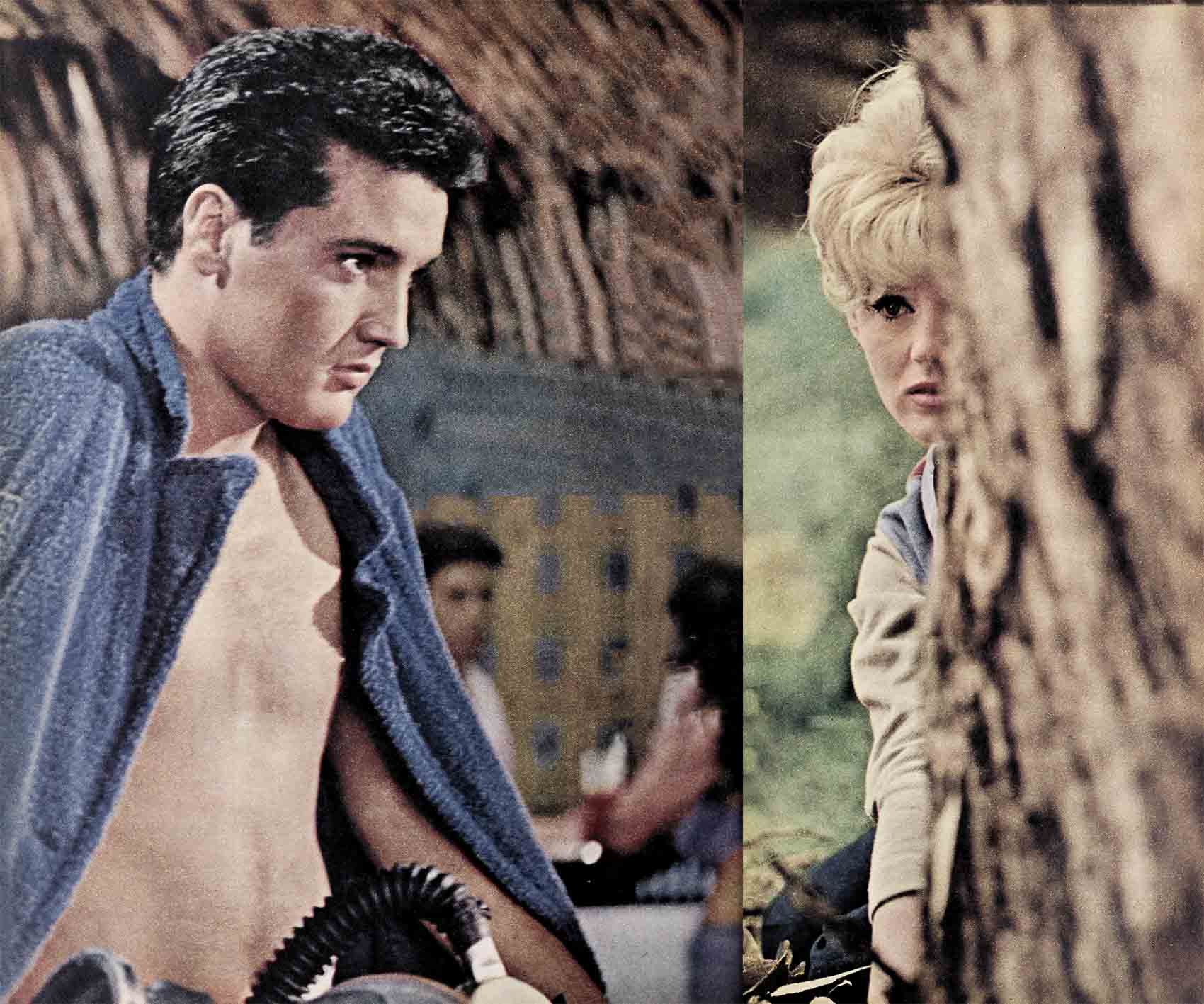
A lonely boy and a girl
Connie and Elvis—so lonely—so eager for the loneliness to end! If a phone rang, if a young man said “Hello,” and a girl said, “Elvis, this is Connie.” what might not happen next?
“This is the supervisor,” a new voice from the telephone told Connie. “May I help you?”
“I hope so.” Connie said. She went through her whole story again.
The supervisor was polite but firm.
“I’m sorry,” she said, “but we can’t give out unlisted numbers under any circumstances. Why don’t you send him a telegram? I’ll return your dime.”
So the dime clinked into the coin box, and Connie dialed Western Union.
Information, the one who had talked so long with Connie, was on her coffee-break by now and was telling her friends about the most recent bid for Elvis’ number.
“The thing is,” she said, “I half-way believe it is Connie Stevens. And if it is, I wish I could give her his number. Wouldn’t it be wonderful if she came all the way here to see him—and they fell in love right here in Memphis—and eloped over the Mississippi line and got married?”
“What an imagination!” scoffed one of the girls. “Do you think if Connie Stevens was in town Elvis wouldn’t know it?
“Maybe he does know it,” broke in another. “Maybe he doesn’t want that girl from Germany to meet her.”
“Or maybe he and Anita are making up and he doesn’t want any interference from other girls. I bet that was Connie Stevens—and Elvis is giving her the brushoff!”
They talked of Elvis with the familiarity of natives who are proud of a local institution.
Meanwhile Connie, still in the phone booth, was dictating the telegram that was to reach Elvis soon and make everything all right.
“I’m in Memphis today,” she began, “and would like to see you. I’ll wait for you to call me at . . .”
“Excuse me. Ma’am.” a young man’s soft Southern voice interrupted. “But if you’ll only be here today. Mr. Presley won’t get this telegram ’till you’re gone.”
“Why?” Connie demanded.
“Because we have orders not to call wires out to Graceland—or even deliver them. We mail ’em out.”
“You what!” Connie nearly shrieked. “I never heard of such a thing! Why can’t you deliver a telegram to Elvis?”
“Well,” the young man said, “I guess it’s because he gets so many, he’d have delivery boys banging on the door all day. And all kinds of people would go bothering him, pretending they work for Western Union.”
He added proudly, “I used to play football with him. But you can’t imagine the trouble he has, trying to get any privacy.”
“I’m beginning to get the picture.” Connie snapped. She was mad at the telegraph clerk, mad at Elvis, mad at herself for being so disappointed.
“Say, Ma’am,” the young man said, “here’s an idea. You could send the telegram to one of Elvis’ friends, and maybe he’d take it over right away. Maybe I could help you. . . .”
“Never mind.” Connie broke in. “I don’t have time to go through all that.”
“And.” she added, her disgust with the whole situation getting the better of her. “Don’t call me Ma’am. I’ll bet you’re older than I am.”
After she hung up, Connie was sorry she’d been so short with the clerk. After all, he did have a way to reach Elvis.
She drew another dime from her coin purse and started to deposit it.
“I’ll call again and apologize to that boy at Western Union.” she thought. “Then I’ll ask him what he can do to help.”
Suddenly, a chilling thought struck her. “But suppose Elvis doesn’t want to see me! He must know I’m in town—somebody must have alerted him! Is he trying to brush me off?”
She answered herself. “I guess he couldn’t know. But. . . .”
Slowly, Connie dropped the dime back into her purse, and pulled out a lipstick instead. Carefully, she painted her lips a warm pink. Then, head high, she walked out of the booth.
—BY NANCY ANDERSON
Connie’s in “Palm Springs Weekend,” WB, and Elvis in “Fun in Acapulco,” Par.
It is a quote. PHOTOPLAY MAGAZINE OCTOBER 1963


